Key Takeaways
- Dominant Market Share: WordPress powers 43.3% of all websites globally as of early 2026.1
- Total Ownership: Being open-source, it provides 100% ownership of data, unlike “rented” SaaS platforms.
- SEO Excellence: Native code structure and advanced tools like Rank Math can improve indexing speeds by up to 25%.
- Scale and Speed: Modern WordPress architectures support over 100,000 concurrent visitors when properly optimized.
- Future Readiness: Integrated AI and “Hybrid Headless” features ensure long-term compatibility with evolving web standards.
Selecting a digital foundation is the most critical decision for your brand’s longevity. While many builders offer simplicity, they often lack the depth required for true business scaling.
There are 7 Powerful Reasons to Build Your Website on WordPress that make it the gold standard for developers and business owners alike. This platform balances high-end technical capability with an accessible interface.
By choosing this ecosystem, you are joining a global community that prioritizes innovation, security, and user freedom. Let’s examine why WordPress remains the unrivaled leader in the CMS market.
Why Has WordPress Become the Global Industry Standard?
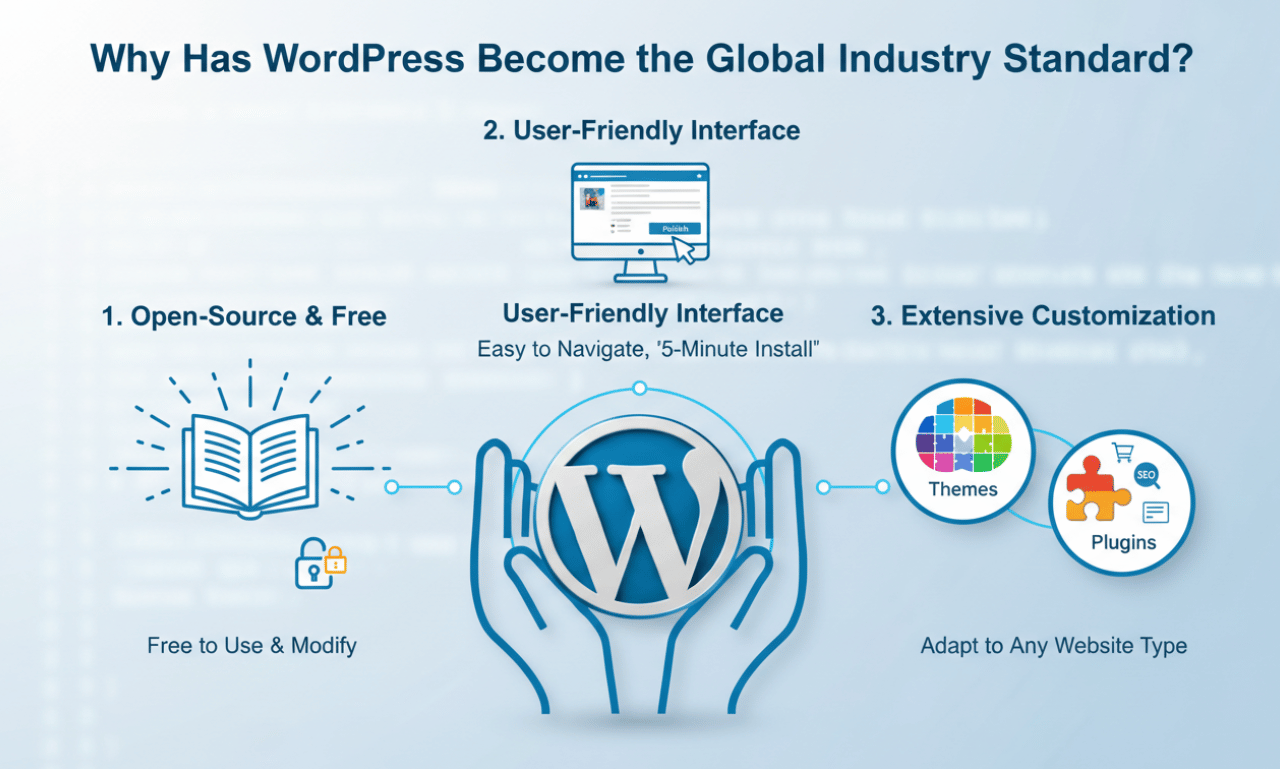
The journey of WordPress from a simple 2003 blogging tool to a massive digital infrastructure is rooted in its open-source philosophy. Historically, web development was gatekept by high licensing fees and proprietary code that locked users into specific vendors.
WordPress disrupted this by utilizing the General Public License (GPL). This allows anyone to study, modify, and distribute the software freely. This transparency built a foundation of trust that attracted both independent creators and Fortune 500 companies.
How did the ecosystem grow so rapidly?
The growth was fueled by the “virtuous cycle” of open source: more users led to more developers, which resulted in better plugins and themes.Today, this has culminated in a library of over 59,000 free plugins and roughly 12,000 free themes, allowing for a level of customization that proprietary builders cannot match.
What Are the Core Benefits of an Open-Source Architecture?
In 2026, “platform risk” is a major concern for businesses. If a proprietary website builder changes its pricing or shuts down, your entire digital presence could vanish. WordPress eliminates this risk by giving you the keys to your own “digital house.”
You own every line of code and every entry in your SQL database.This means you can move your site to any hosting provider in the world at any time without asking for permission.
Is the software really free?
The core software remains free. While professional sites require investments in Managed WordPress Hosting, premium security, and specialized themes, the lack of a “platform tax” allows you to reallocate your budget toward marketing and content creation.
How Does WordPress Handle Modern Security and Compliance?
With global data regulations like GDPR and WCAG 2.2 accessibility standards becoming stricter, your CMS must be proactive. WordPress includes built-in tools for data export and erasure requests to ensure legal compliance.
According to Ciaran Connolly, Founder of ProfileTree:
“WordPress gives businesses something most platforms cannot offer: genuine ownership. You own your website completely. You can scale without asking permission or paying ransom fees.”
What are the current security standards?
- Automatic Patching: WordPress core can auto-update to fix critical vulnerabilities within minutes of discovery.
- Encryption: Full support for SSL/TLS is standard, ensuring all data transmission is secure.
- Application Firewalls: Plugins like Wordfence or Patchstack provide real-time threat intelligence and virtual patching.
| Feature | WordPress (Self-Hosted) | SaaS Site Builders |
| Market Share (2026) | 43.3% | 2.1% – 4.4% |
| Data Ownership | 100% User Owned | Provider Owned |
| Plugin Ecosystem | 59,000+ | Limited “App Store” |
| SEO Flexibility | Unlimited | Restricted by the GUI |
| Future Proofing | High (Open Source) | Moderate (Proprietary) |
Why is WordPress Considered the Best for SEO?
Google’s algorithms prioritize websites that are fast, mobile-responsive, and clearly structured. WordPress is built with high-quality, semantic HTML5 code, which search engine crawlers prefer.
Which SEO features drive results?
- Custom Permalinks: You have total control over URL structures to include target keywords.
- Schema Markup: Easily add structured data so your site appears in “Rich Snippets” or AI-generated search summaries.
- Core Web Vitals: Modern themes are optimized for Largest Contentful Paint (LCP), aiming for load times under 2.5 seconds.
Research indicates that WordPress sites using optimized caching and modern image formats (like WebP) can achieve a 35% higher performance score than generic site builders.
Can WordPress Scale for High-Traffic Enterprise Sites?
There is a misconception that WordPress is only for small-scale projects.In reality, it powers some of the most complex sites on the planet.
Who uses WordPress at scale?
- The White House (WhiteHouse.gov)
- Microsoft News
- The Walt Disney Company
- NASA
These organizations utilize WordPress VIP or custom-clustered server environments to handle millions of visitors per month. The platform’s ability to integrate with Redis, Memcached, and Content Delivery Networks (CDNs) makes it incredibly robust under heavy load.
How Does the Plugin Ecosystem Simplify Web Development?
The true power of WordPress lies in its extensibility. You can add complex functionality to your site without hiring a full-time developer for every minor change.
What functionality can you add?
- E-commerce: WooCommerce currently drives roughly 33% of all online stores, offering a complete checkout and inventory system.
- Learning Management: Tools like LearnDash allow you to host courses and issue certifications.
- Membership Portals: Create gated content and subscription tiers with ease.
- AI Integration: In 2026, plugins now offer real-time AI content suggestions and automated image optimization directly in the dashboard.
What Does the Future of WordPress Look Like in 2026 and Beyond?
The platform is currently moving into a new era of Full Site Editing (FSE) and AI-assisted design. The transition to a “Block-first” architecture means that even non-technical users can design professional layouts.
What are the expected updates?
- Hybrid Headless Standard: Using WordPress for content management while delivering the frontend via fast frameworks like React or Next.js.
- Native Multilingual Support: A core feature currently in development to allow for easier global reach without third-party plugins.
- Collaborative Editing: Real-time co-editing features, similar to Google Docs, are becoming standard in the Gutenberg editor.
Is WordPress Easy to Learn for Non-Technical Users?
While the platform has a slight learning curve compared to “drag-and-drop” only tools, the long-term payoff is significantly higher. The interface is intuitive, and the media management system is the best in the industry.
How can a beginner manage their site?
- Visual Editors: Use the Block Editor to see exactly how your page will look before you hit publish.
- Dashboard Simplicity: Manage your blog, pages, and comments from one centralized location.
- Massive Documentation: There are over 2.5 million tutorials available online to help you troubleshoot any issue.
How Does WordPress Address Data Sovereignty?
As we move deeper into 2026, data sovereignty—the idea that data is subject to the laws of the country in which it is located—is vital. Because you choose your host with WordPress, you can ensure your data is stored in specific jurisdictions (like the EU for GDPR compliance).
This level of control is impossible with SaaS builders that host your data on their own proprietary, often US-based, servers. For businesses handling sensitive customer information, this is a non-negotiable requirement.
Conclusion
Building a website is an investment in your brand’s future. By choosing a platform that offers total ownership, unmatched SEO capability, and a clear path to enterprise-level scaling, you are setting yourself up for sustained success.
The 7 Powerful Reasons to Build Your Website on WordPress—from its massive market share to its open-source freedom—demonstrate why it remains the most logical choice for 2026. Whether you are launching a personal project or managing a global corporation, WordPress provides the flexibility and power to turn your vision into a high-performance reality.
Output clean markdown, ready to publish.
Would you like me to generate a custom 12-month maintenance checklist to keep your WordPress site secure and fast throughout 2026?